Monday, June 19, 2017

Imagining the Past Podcast Series: Sophie Masson


HNSA is proud to announce the release of our 'Imagining the Past' podcast series which is a foretaste of the novelists you'll hear at the 2017 HNSA Conference in Melbourne from 8-10 September at Swinburne University, Hawthorn. This week we bring you our 2017 Conference Patron, Sophie Masson, chatting with our host, Kelly Gardiner. More information about the programme is available at our website. 


Sophie Masson was born in Indonesia of French parents and brought up in France and Australia, Sophie Masson is the award-winning and internationally-published author of over 60 books for children, young adults and adults. Her historical novel for children, The Hunt for Ned Kelly, won the Patricia Wrightson Prize in the NSW Premier's Literary Awards in 2011, while her alternative history novel for young adults, The Hand of Glory, won an Aurealis Award and her historical fantasy trilogy, Forest of Dreams, has been translated into several languages. Sophie's newest novel is Jack of Spades, a historical spy novel for young adults, coming out with Eagle Books in 2017. Sophie is also co-founder and director of small-press publishing house, Christmas Press, and serves on the Boards of the Australian Society of Authors, the Small Press Network and the New England Writers' Centre.You can connect with Sophie via her website, blog, Facebook or Twitter.


May 1910…

Linda’s father is missing in Paris, and her only clue is the Jack of Spades card that was sent to their home in London. In the family code, ‘Jack of Spades’ means danger. But it is not her father’s handwriting on the envelope!

Setting out to look for him, Linda is soon whirled into a frightening world where nothing is as it seems. Who are the people following her? What was her father really doing in Paris? Who can she really trust? As she works against time to try and solve the mystery of her father’s disappearance with the help of some new friends, Linda begins to realise that she has stumbled into a dark and dangerous conspiracy which threatens the future of the whole world…

Our Imagining the Past Host:


Kelly Gardiner’s most recent book is 1917 (published early in 2017), a novel for young readers set during the First World War. Her previous books include Goddess, based on the remarkable life of the seventeenth century French swordswoman and opera singer, Julie d’Aubigny. Kelly’s historical novels for young adults include The Sultan’s Eyes and Act of Faith, set during the time of the English Civil Wars and the Inquisition. Both books were shortlisted for the Ethel Turner Prize in the NSW Premier’s Literary Awards. Her books for younger readers are the ‘Swashbuckler’ adventure trilogy – Ocean Without End, The Pirate’s Revenge and The Silver Swan – set in Malta during the Napoleonic invasion, and a picture book, Billabong Bill’s Bushfire Christmas. Kelly has worked on newspapers, magazines and websites, and her articles, poems, book reviews and travel writing have appeared in journals, magazines and newspapers as diverse as ‘The New York Times’, ‘Marie Claire’, ‘New Idea’, and ‘Going Down Swinging’. She works at the State Library of Victoria and teaches creative writing at La Trobe University. Kelly is also the co-host of Unladylike, a podcast on women and writing. Learn more about Kelly at her website. https://kellygardiner.com/

HNSA 2017 Conference

The HNSA 2017 Melbourne Conference is being held on 8-10 September 2017 at Swinburne University. Sophie will be appearing at HNSA 2017 our Personal History session on Sunday 10 September at 11.30 -12.30 in conversation with Lucy Treloar and Jackie Ballantyne.

This celebration of the historical fiction genre will showcase over 60 speakers discussing inspiration, writing craft, research, publishing pathways and personal histories in our weekend programme. Among the many acclaimed historical novelists participating are Kerry Greenwood, Kate Forsyth, Deborah Challinor, Libby Hathorn, Lucy Treloar, Sulari Gentill, Robert Gott and Arnold Zable. The HNSA’s speakers’ list is available on the HNSA website.

In addition to the two stream weekend programme, there will be ten craft based super sessions and two research masterclasses. You won’t want to miss our interactive sessions on armour and historical costumes either! Manuscript assessments will be conducted by industry experts, Alison Arnold and Irina Dunn. Our free extended academic programme is open for general admission but bookings are essential.

Our First Pages Pitch Contest offers an opportunity for submissions to be read aloud to a panel of publishers. And we are delighted to announce the introduction of our inaugural HNSA Short Story Contest with a $500 prize!


Thursday, June 15, 2017

Interview with Paul Hansen and Linda Weste


A treat today for lovers of Ancient Roman and Greek history, myths and legends, as well as politics, murder and intrigue.

Linda Weste is an author, reviewer, editor, and teacher. Her recent historical verse novel set in late Republican Rome, Nothing Sacred, won the 2016 Wesley Michel Wright Prize, and was highly commended in the Fellowship of Australian Writers 2015 Anne Elder Award. Weste reviews for online journals including Mascara Literary Review and Cordite Poetry Review, teaches creative writing, and is Reviews Editor of TEXT. She has a Doctor of Philosophy (Creative Writing) from the University of Melbourne.

Paul Hansen has worked in law enforcement for 23 years and is currently the Director for a criminal investigation unit. One of his most interesting jobs was as head of international family law in the Federal Attorney-General’s Department, where he ran the Australian Central Authority for International Child Abduction and  twice represented Australia as head of delegation in The Hague. Paul also loves writing stories –not just the standard stuff.  he love the small bits that you don’t normally find until you dig deep. For him classical literature, and ancient writers like Herodotus, Hesiod, Homer, and others, are great examples of this. Paul’s‘Last War of Gods and Men’ series – put all the myths and legends into a single tale – a tapestry – that shows how everything was interwoven in a way that is easy for the modern reader to digest, without having to spend years studying the classics in a University. You can connect with Paul via his website, Facebook and Twitter.

What is the inspiration for your current book?


Linda: The historical fault line between the collapse of the Roman Republic and the rise of the Imperium during the first century BCE has long fascinated writers. I became fascinated with this period after discovering a footnote about Clodia Metelli in a book of Catullan poetry. A German scholar had mapped Clodia onto Catullus's 'Lesbia' in 1862. Clodia and her brother Clodius Pulcher were born into the Claudii Pulchri, one of only twenty families who guided senatorial policy, commanded the armies and governed the provinces in late Republican Rome. The impression of Clodia and Clodius as firebrands – determined to live by their own rules – inspired me to imaginatively bring to life the vagaries of the period through their eyes and exploits in my current book, Nothing Sacred.

Paul: Sword of Olympus is the first book in a five book series based on ancient writings and fragments dating back to the 7th Century BCE.  It details the civil war and split between the Gods and Goddesses of Mount Olympus, a split which was reflected in the mortal realm in a war between the many cities and tribes of ancient Greece – and eventually culminated in the war with Troy.  It is the thrill of placing these myths and legends all together into a single coherent tapestry which inspires me – and rediscovering small pieces of information and knowledge that we have lost over time.

Bits like Helen of Troy was actually never at Troy.  The warrior Achilles and the Priam of Troy were not their real names – but derogatory references or nicknames.  How did Agamemnon become king of Mycenae – when his family wasn’t originally in control of the city, and as a child he was a fosterling without a kingdom?  Where was the most important family of ancient times during the war with Troy – the Hellenes, after whom the Greeks (and the modern country of Greece) take their name?


Is there a particular theme you are exploring in this book?


Linda: As a novel in verse, Nothing Sacred offers a fresh way of knowing late Republican Rome through the medium of poetry. It also differentiates its representation of late Republican Rome from other historical novels set in this time, by not being solely about the triumvirate leadership of Crassus, Caesar and Pompey. The theme I'm most interested in is transgression – which is closely linked with desire, hence the book's frequent use of sexual metaphors – metaphors that have been with us since antiquity.

Paul: I wanted to tell the story of the myths and legends of Ancient Greece, but in a way that the ancients themselves would have understood.  To them myth and wasn’t just a bunch of individual stories – it was history!  There was even a profession in the ancient world that set the myths and legends into a historical frame – mythographer.

Which period of history particularly interests you? Why?


Linda: Antiquity – but while I'm interested in what existing representations of history tell me, I'm more interested in what they don't tell me; the facts that aren't readily accessible are what I'm most curious to learn.

This curiosity shapes my view that historical fictions can fill the gap between the pasts we are permitted to know and those we wish to know.

Paul: I am interested in all history – but in particular areas that converge with myth and legend, which after all is only history that we’ve forgotten or remembered slightly differently.

What resources do you use to research your book? 


Linda: For Nothing Sacred I undertook extensive research: Catullan poetry; Latin and Greek etymology; numismatics; naming conventions; architecture and monuments; political speeches; ancient place names and geographical boundaries; agricultural methods and food preparation; festivals and artefacts; gender and sexuality; mythology and religion; slavery; gladiatorial combat; and use of animals for pleasure and show.

The many resources included digital material for the study of girls and women in antiquity, classical libraries, museum archives, a corpus of Latin inscriptions and a topographical dictionary of Ancient Rome.

Paul: I try to track down as many original sources as possible – which with Greek myth is a mix of translated ancient texts, fragments, and archaeology.

What is more important to you: historical authenticity or accuracy?


Linda: I had to decide which approach – historicism or presentism – would be best for my representation of late Republican Rome in Nothing Sacred.  If I chose an historicist approach – to honour historical actuality, authenticity and factuality – I could risk making my representation of the times inflexible, unresponsive to fiction's needs. If I chose a presentist approach – imposing present-day attitudes on the past could stifle the 'otherness' of antiquity.

I faced the decision anew with each poem. In 'Gargantuan' for example, I recount – in the voice of the character, Cicero – the killing of twenty elephants (an actuality). To do so, I had to think about this death as a Roman of the times might (authenticity). But to engage today's readers – who would likely view the killing with revulsion – and draw attention to the significance of the incident for the times, I aestheticised the scene, and made the language as beautiful and beguiling as I could.

Paul: I try for both.  There is usually a way to turn the facts to fit the story you want to tell – but you also have to be willing to let the facts guide the story, and take you in directions you might not have originally anticipated.  For me that is the absolute joy of writing historical fiction.

Which character in your current book is your favourite? Why?


Linda: Definately the siblings Clodius Pulcher and Clodia Metelli – their audacity is fascinating.  

Paul: Dorus – king of the Hellenes.  He is a complex character and one that is almost completely forgotten in the modern myths, but he was the founder of one of the three branches of ancient Hellenism – the Dorians.  He finds himself out of his depth, trying to live up to the memory of his father, the warrior king Hellen (after whom the Hellenes are named) and having to deal with the fact that his nephew Macedon (after whom the Macedonians are named) has turned out to the a son of Zeus.  Writing his internal struggle was enjoyable.

The other character I really like is the Oracle Dodona – she’s a mysterious and unknown factor, and is clearly reading from a different papyrus scroll than everyone else.  What else would you expect from an Oracle?

Are you a ‘plotter’ or a ‘pantser’? How long does it generally take you to write a book?


Linda: I'm a plotter definitely. This book took several years to research and write.

Paul: It generally takes me about a year to write – but a large part of that is research.  My books are also quite large – around 150K words each.

Which authors have influenced you?


Linda: For this work I was probably influenced most by Robert Harris – his first rule of historical fiction is not to use your research, or at any rate to use only a tenth of it.  Harris warns against ‘the temptation to stick in facts just because you’ve discovered them’. In the best historical fiction, the reader can sense the presence of the research that isn’t being used, out there in the shadows… the novelist’s function according to Harris, is to take the research and convey impressions – to go beyond the bare facts.

Paul: Sara Douglass; David Gemmell; Valerio Manfredi; Rick Riordan

What advice would you give an aspiring author?


Linda: Research as much as possible and have a good reason for whatever choices you make.

Paul: Research as much as possible – and map out all your key facts and characters.  Seek input and feedback on your writing – but don’t take no for an answer. 

Tell us about your next book or work in progress


Linda: The next book is an historical novel in verse – set in Melbourne during World War Two. I'm interested in this as a period of complex social change, for the Second World War engaged the entire Australian community in a way that the Great War did not. 

Paul: I’m currently working on book III in the series – The Dragon Throne (yes – they had dragons in ancient Greece.  The Oracle in Delphi is even named after one – the great She-Dragon Delphyne!).  The focus of the book is the brothers Agamemnon and Menelaus – and how they move from being homeless youth to retaking Mycenae from their uncle, and then bringing the rest of the Greek Peninsula to heel.  It wasn’t just armies – there was a lot of political intrigue between the various cities, tribes – and even the Gods themselves.


They may have been born privileged into the Claudii Pulchri family, but siblings Clodius Pulcher and Clodia Metelli are firebrands: kindred spirits; brazen, impetuous, headstrong; determined to live by their own rules.

Together they incite the wrath of Rome’s elite - and in particular, Cicero. But nothing is sacred in late Republican Rome - and rules keep changing when change threatens to rule …
The vagaries of the period are brought to vibrant life through the eyes and exploits of Clodius and Clodia in this historical novel in verse.

Nothing Sacred is available at Readings or Scholarly


In an ancient world of gods and heroes, the threat of war is rising…

From the city of Trachis, near the pass of Thermopylae, three kings set sail for the holy island of Asteria and the gathering of kings called by the twin temples of Apollo and Artemis, intent on foiling the plans of Atreus, king of Mycenae, who seeks dominion over all the cities and kingdoms of the Aegean sea.

To the north, in the shadow of Mount Olympus, the hero Heracles looks to free the besieged city of Elone, joining forces with the Centaurs to wage war against the combined armies of Lapith and Dryopes warriors, who under the command of the Strategos Coronus have been ordered to destroy the city of the Hellenes.

While Hera, the outcast Queen of the Gods, strives to raise a new god to cast aside the old, and will sacrifice the immortals of Pelasgia to achieve her goal. Yet all the while the question remains, where are the other Olympians?

Against a backdrop of war and betrayal, a young man will struggle to understand the power of the gods, and his role in the struggle to come. In an ancient world of gods and heroes, the threat of war is rising… And if they are not careful, the Dark Queen will sacrifice all to chaos.

Sword of Olympus and Rage of a Dark Queen are available via Amazon.


HNSA Meet the Author Satellite Event

Paul Hansen and Linda Weste are appearing in our Melbourne HNSA Meet the Author event on 18 June 2.30-4.30 pm at the Mail Exchange Hotel, 688 Bourke St, Melbourne discussing Ancient and Medieval Historical Fiction with Barbara Gaskell Denvil, Lindy Cameron and Rachel Nightingale. Bookings essential. More details can be found on the HNSA website.

HNSA 2017 Conference

The HNSA 2017 Melbourne Conference is being held on 8-10 September 2017 at Swinburne University.

This celebration of the historical fiction genre will showcase over 60 speakers discussing inspiration, writing craft, research, publishing pathways and personal histories in our weekend programme. Among the many acclaimed historical novelists participating are Kerry Greenwood, Kate Forsyth, Deborah Challinor, Libby Hathorn, Lucy Treloar, Sophie Masson, Sulari Gentill, Robert Gott and Arnold Zable. The HNSA’s speakers’ list is available on the HNSA website.

In addition to the two stream weekend programme, there will be ten craft based super sessions and two research masterclasses. You won’t want to miss our interactive sessions on armour and historical costumes either! Manuscript assessments will be conducted by industry experts, Alison Arnold and Irina Dunn. Our free extended academic programme is open for general admission but bookings are essential.

Our First Pages Pitch Contest offers an opportunity for submissions to be read aloud to a panel of publishers. And we are delighted to announce the introduction of our inaugural HNSA Short Story Contest with a $500 prize!


Let’s make a noise about historical fiction!

Monday, June 12, 2017

Interview with Rachel Nightingale


Our guest today is Rachel Nightingale. Rachel has been writing since the age of 8 (early works are safely hidden away). She holds a Masters degree and PhD in Creative Writing. Winning the Mercury Short Story competition (junior section) at the age of 16 fueled her desire to share her stories with the world. Subsequent short stories have been shortlisted in a number of competitions and a play, No Sequel, won the People's Choice Award and First Prize at the Eltham Little Theatre's 10 Minute Play competition. Another, Crime Fiction, was performed at Short and Sweet Manila and Sydney.

Rachel’s second passion after writing is the theatre, and she has been performing in shows and working backstage for a rather long time. She co-wrote and performed in the 2013-2015 version of the hugely popular Murder on the Puffing Billy Express, a 1920s murder mystery set on the iconic Dandenong Ranges train. The inspiration for the Tarya trilogy, which begins with Harlequin's Riddle, began when she read a quote by Broadway actor Alan Cumming about that in-between moment just before you step onstage, and began to wonder might be found in that place between worlds. You can connect with Rachel via Facebook and Twitter or her blog.


What is the inspiration for your current book?

 Harlequin’s Riddle grew out of an article I read about the Broadway revival of Cabaret. Alan Cumming, who was playing the emcee, spoke of the moment before you step on stage as being a ‘moment between’ where anything was possible, like the Hindu idea of heaven, or Turiya. Hence the idea for Tarya was born, a realm that artists enter when they are in the flow of creating their art. The fun part was working out exactly what becomes possible in this realm.


Is there a particular theme you are exploring in this book?

We’re at a point in time where technology has enabled anyone to produce a professional looking ‘product’, whether that be a film, book or digital art, and many people think that’s a substitute for hard work, original ideas and getting good at your craft. We’re seeing the rise of very formula ‘art’, where people copy what others have done to try to capture their success. This is encouraged by the big entertainment corporations who hold the marketing strings. The fact that the final decision about whether a book will be published is made by the marketing department on the basis of whether it will sell, not by a skilled editor who knows good storytelling, is appalling. So in the Tarya Trilogy artists’ work is proscribed – they are not allowed to do anything that is too original or that might actually move or transport the audience. If they do, they are severely penalised.

Which period of history particularly interests you? Why?

The Tarya trilogy is fantasy, but it is essentially set in the Italian Renaissance. I have only stepped sideways into a fantasy world in order to bring magical experiences into the story. The books centre on the travelling players, the Commedia dell’Arte (Harlequin, Columbine, Pierrot and others), who travelled around Italy in the 1500s. The setting and costumes are all based on that era, and the arc of the story, in terms of the dominance of the Commedia dell’Arte as an artform, follows historical occurrences.

What resources do you use to research your book?

As a historical reenactor, I have researched, made and worn Italian Renaissance dresses, so that very much feeds into what people are wearing in the books. Being in the SCA provides fabulous research opportunities because there is always someone who has done in-depth research on something you want to know about and is happy to share their knowledge, or point you in the right direction. I have also done mask making and have an extensive background in theatre and improv so the performance side of things comes from direct experience. John Rudlin’s book, Commedia dell’Arte, An Actor’s Handbook, was a key resource. I used other resources on the Renaissance for things like the ‘Memento Mori’ skeleton jewellery that appears in the second book. In terms of setting I experienced one of those inexplicable things that sometimes happen to writers – I describe towns and cities with buildings covered in tiles that form pictures. I’ve never been to Europe, but after I’d written these descriptions I found photographs of European towns where these buildings existed!

What is more important to you: historical authenticity or accuracy?

Writing fantasy gives me the room to play with things, so I’d have to say I aimed for an authentic feel as the backdrop to the more magical occurrences rather than trying to get things exactly write, although sometimes I do work from an image (eg a piece of artwork from the time) and try to describe it as accurately as possible. I’m currently writing a play based on a historical figure though, and that is completely different – I am absolutely aiming for accuracy. Her life is pretty dramatic, so I definitely don’t need to make things up to create drama. 

Which character in your current book is your favourite? Why?

Luka, who plays Pierrot onstage, has to be my favourite. You don’t see much of him in the first book, but he becomes increasingly important in the second and third books. He’s quiet and gentle, the antithesis of Hollywood’s definition of a hero, but without him Mina’s story would be very different.

 Are you a ‘plotter’ or a ‘pantser’? How long does it generally take you to write a book?

Definitely a plotter. When you’re writing over three books you have to keep track of plot points closely, and it was important to me to seed events or ideas in the first book that would come to fruition in the final one, so that meant thinking it all through well in advance. I much prefer reading books that do this, so that’s my aim. I’m hoping my writing speed picks up – real life has always got in the way so writing has been a slow, slow process, but I’m making it a priority now. The second book in the Tarya trilogy, which will come out in the middle of next year, is already complete luckily so I have a bit of time to work on the third one!

Which authors have influenced you?

I nearly failed my first year of university because I spent swot vac reading The Mists of Avalon, by Marion Zimmer Bradley. The way in which she takes myth and makes it believably real in a historical context is a huge inspiration for me. I also love Ray Bradbury’s wordsmithing ability – I hope to be half as good as him in a few more decades.

What advice would you give an aspiring author?

Read and write a lot, and if you seriously want to be a writer, take your writing seriously. There is some luck involved, but a lot of it is hard work, professionalism and the willingness to keep developing your craft.

Tell us about your next book or work in progress.

I’m writing a full length play about an intriguing historical figure. It started out as a ten minute play, but she wasn’t happy with having such a short time to tell her story! I’m working out how I can use theatrical techniques to play around with the idea of truth in the story of someone’s life. I’m hoping by interval I can convince the audience of one thing, then show them after interval that this can’t possibly be true!


The Gazini Players are proud to present
For your Edification and Enjoyment
Tales of great Joy, and of great Woe

Ten years ago, Mina’s beloved older brother disappeared with a troupe of Travelling Players, and was never heard from again.

On the eve of Mina’s own departure with a troupe, her father tells her she has a special gift for Storytelling, a gift he silenced years before because he was afraid of her ability to call visions into being with her stories.

Mina soon discovers that the Travelling Players draw their powers from a mysterious place called Tarya, where dreams are transformed into reality.  While trying to solve the mystery of her brother’s disappearance, she discovers a dark cost to the Players’ onstage antics. Torn between saving her brother or exposing the truth about the Players, could her gifts as a storyteller offer a way to solve Harlequin’s riddle?

Thanks Rachel. Good luck with your debut!

Harlequin's Riddle is available via Odyssey  Books.


HNSA 2017 Conference

The HNSA 2017 Melbourne Conference is being held on 8-10 September 2017 at Swinburne University. Rachel Nightingale is a busy girl! She will be appearing in in Session Three on Saturday 9 September at 11.15am-12.15pm.

How to Transmute Research into Compelling Historical Fiction
A passion for research doesn’t always translate into creating compelling fiction. Gillian Polack discusses the challenges of converting historical facts into page turning novels with Wendy J Dunn, Barbara Gaskell Denvil, Stephanie Smee and Rachel Nightingale.

She is also acting as our narrator in our First Pages Pitch Contest on Saturday 9 September and will be conducting a super session on Recreating Historical Costumes on Sunday 10 September.

What is it like to wear a Tudor outfit or dance in a Renaissance dress? How heavy is an ancient Chinese hanfu and how much fabric goes into its creation? These questions and more will be answered by Rachel Nightingale in this workshop, where you will have a chance to get up close and personal with a range of outfits made by historical re-enactors based on research and portraits. You will have the chance to look at a number of costuming books that deconstruct historical costumes, and perhaps even to try on a historical outfit. 

Rachel is also appearing in our Meet the Author satellite event on 18 June at the Mail Exchange Hotel, 688 Bourke St, Melbourne from 2.30-4.30pm discussing Ancient and Medieval Fiction with Lindy Cameron, Barbara Gaskell Denvil, Linda Weste and Paul Hansen. More information and tickets are available from the HNSA website. 

The conference is a celebration of the historical fiction genre which will showcase over 60 speakers discussing inspiration, writing craft, research, publishing pathways and personal histories in our weekend programme. Among the many acclaimed historical novelists participating are Kerry Greenwood, Kate Forsyth, Deborah Challinor, Libby Hathorn, Lucy Treloar, Sophie Masson, Sulari Gentill, Robert Gott and Arnold Zable. The HNSA’s speakers’ list is available on the HNSA website.

In addition to the two stream weekend programme, there will be ten craft based super sessions and two research masterclasses. You won’t want to miss our interactive sessions on armour and historical costumes either! Manuscript assessments will be conducted by industry experts, Alison Arnold and Irina Dunn. Our free extended academic programme is open for general admission but bookings are essential.

Our First Pages Pitch Contest offers an opportunity for submissions to be read aloud to a panel of publishers. And we are delighted to announce the introduction of our inaugural HNSA Short Story Contest with a $500 prize!


Let’s make a noise about historical fiction!

Thursday, June 8, 2017

Interview with Barbara Gaskell Denvil


Our guest today is Barbara Gaskell Denvil, author of The Flame Eater, Sumerford’s Autumn, Fair Weather and many more. Her full list is available on her website. You can connect with Barbara via Facebook and Twitter.

Tell us a little about yourself.

I was born in Gloucestershire, England and later moved to London where I grew up surrounded by books, paintings and antiques. My father was an artist and playwright, my mother a teacher, and my elder sister a successful author first published at age 16. The classic Victorian author Mrs Elizabeth Gaskell was a great, great, great aunt. We were a bookish family. I have worked in many literary capacities, as a publishers’ reader, a television researcher and script writer, an editor, literary critic and published numerous short stories and articles. Then motherhood took precedence. Having three young daughters, two of whom were identical twins, writing had to take a back seat.

Years later I moved to Australia where I now live in a semi-rural area of exceptional beauty, watching the amazing birds and wildlife, and at last writing full length novels. My passion is for late English medieval history and this forms the background for my historical fiction. I also have a love of fantasy and the wild freedom of the imagination, with its haunting threads of sadness and evil. Although all my books have romantic undertones, I would not class them purely as romances. Although we all wish to enjoy some romance in our lives, there is also a yearning for adventure, mystery, suspense and experience. My books include all of this and more, but my greatest loves are the beauty of the written word, and the utter fascination of good characterisation. Bringing my characters to life and taking the reader with me, is my principal aim. I am now self publishing my books, as I found that traditional publishing is not what it used to be. I now have total control over content, covers and titles. With advice from my lovely agent Sheila Drummond, we have hopefully everything covered.

What is the inspiration for The Flame Eater?

I discovered a little known fact occurring during the time period in which my book is set, and this inspired me to look further and develop the situation.

Is there a particular theme you are exploring in this book?

I believe the theme for me is twofold both the detailed extent to which characterisation can be developed and yet remain believable, and also the complex possibilities of the crime mystery, while retaining the surprise ending.

Which period of history particularly interests you? Why?

The late medieval period interests me most. I believe that the modern standards and ideals began during Edward IV’s reign, and continued to develop from there. I also became interested in the character of Richard III, and enjoyed the research to discover whether this was the villain or the hero of the late 15th century.

What resources do you use to research your book?

I have been researching this period for many years. I used to read constantly and studied both original and secondary sources. I am no longer able to read so much since I am losing my eyesight, but I still study when I can.


What is more important to you: historical authenticity or accuracy?

Both. I see them as essential in every way. Accuracy is my particular priority, but authenticity is much the same thing as far as I am concerned.

Which character in your current book is your favourite? Why?

Both Nicholas and Avice, simply because I find them both intensely alive, and I thoroughly enjoyed giving them both reality.

Are you a ‘plotter’ or a ‘pantser’? How long does it generally take you to write a book?

Most of my books have taken approximately 7 to 8 months. And yes, like you I am definitely a ‘Plantser’. 

Which authors have influenced you?

Oh, gracious, every single book I have ever read in one way or another. I suppose Dorothy Dunnett was a principal influence amongst historical authors.

What advice would you give an aspiring author?

To write and then rewrite over and over again. Believe in yourself and don’t listen to advice!

Tell us about your next book or work in progress.

I am now starting a children’s series which is partially historical and partially fantasy. This first book (Bannister’s Muster – Book 1 – SNAP) will be published in early June.  I am so enjoying bringing my favourite medieval era alive for children (8 – 15 year olds).


Intrigue, Romance and Adventure, the ideal escape when curled up with a good book. Nicholas, now heir to the earldom, has no desire to marry his dead brother’s cast-off. Emeline has no desire to marry the brutal monster who murdered his brother, the man she loved and hoped to marry. This arranged marriage is a disaster, Fire rages through the castle and takes over the wedding night, and any hopes of reconciliation. Murder and arson are destroying more than one alliance, the culprit unknown.

It is 1484 and Richard III is England’s monarch. The king entrusts many of his lords in the service of their country, so Nicholas is charged with the undercover investigation into desperately important situations.

Emeline joins with her younger sister and others of the household, determined to discover who is responsible for the disasters which have entirely disrupted their lives. But the suspects are so many. It is therefore a group of eager but desperate women of various ages, characters and capabilities who attempt to solve the mystery. Meanwhile, Nicholas learns that he has a wife to admire and to adore.

But is he a murderer? Is her mother? Her nurse? And will England’s political turmoil threaten their peace and cause even greater uncertainty? Life will never be the same. But perhaps that is just as well.

Many thanks Barbara! 

The Flame Eater is available via Amazon US, Amazon UK and Amazon AU. 

HNSA 2017 Conference

The HNSA 2017 Melbourne Conference is being held on 8-10 September 2017 at Swinburne University. Barbara Gaskell Denvil will be appearing in in Session Three on Saturday 9 September at 11.15am-12.15pm.

How to Transmute Research into Compelling Historical Fiction
A passion for research doesn’t always translate into creating compelling fiction. Gillian Polack discusses the challenges of converting historical facts into page turning novels with Wendy J Dunn, Barbara Gaskell Denvil, Stephanie Smee and Rachel Nightingale.

Barbara is also appearing in our Meet the Author satellite event on 18 June at the Mail Exchange Hotel, 688 Bourke St, Melbourne from 2.30-4.30pm discussing Ancient and Medieval Fiction with Lindy Cameron, Rachel Nightgale, Linda Weste and Paul Hansen. More information and tickets are available from the HNSA website. 

The conference is a celebration of the historical fiction genre which will showcase over 60 speakers discussing inspiration, writing craft, research, publishing pathways and personal histories in our weekend programme. Among the many acclaimed historical novelists participating are Kerry Greenwood, Kate Forsyth, Deborah Challinor, Libby Hathorn, Lucy Treloar, Sophie Masson, Sulari Gentill, Robert Gott and Arnold Zable. The HNSA’s speakers’ list is available on the HNSA website.

In addition to the two stream weekend programme, there will be ten craft based super sessions and two research masterclasses. You won’t want to miss our interactive sessions on armour and historical costumes either! Manuscript assessments will be conducted by industry experts, Alison Arnold and Irina Dunn. Our free extended academic programme is open for general admission but bookings are essential.

Our First Pages Pitch Contest offers an opportunity for submissions to be read aloud to a panel of publishers. And we are delighted to announce the introduction of our inaugural HNSA Short Story Contest with a $500 prize!


Let’s make a noise about historical fiction!

Monday, June 5, 2017

Interview with Lisa Chaplin


Our guest today is Lisa Chaplin. Lisa is a former nurse, wife and mother of three who has sold more than 1.6 million books worldwide with 20 published romance and historical fiction novels. The Tide Watchers was her first published historical fiction, published across the English-speaking world by HarperCollins. Her next historical fiction is Incomparable Shadows, a real Scarlet Pimpernel novella, and The Memory of Cardamom series, about the young prophetess forced to marry the king who murdered her husband. Her agent is Eleanor Jackson of Dunow, Carlson and Lerner Literary Agency in New York. You can connect with Lisa via her website, Twitter and Facebook. 

In the lead up to the 2017 HNSA Conference in Melbourne, we thought readers would like to know a few of Lisa's favourite things. Could you please share with us what is or was your favourite...

Book as a child and as a teenager? 

Heidi and Little Women, and the What Katy Did series. Then The Lord of the Rings, and Anne of Green Gables.

Author/authors?

Definitely Tolkien, as well as Sharon Penman, M.L. Stedman, Markus Zusak, Kate Forsyth, Robyn Cadwallader, Kate Mosse, Alice Hoffman and Kate Morton...the list grows. I constantly try new authors, and add many to my list.

Period of history?

All of them! I adore hidden history in any era – it fascinates me. But I do have a sneaking fondness for ancient Near East history. It takes time and patience to find the story between the wide cracks of accepted history, always changing with new findings. Going to Israel and Jordan changed my writing life. I now dream of getting a residency in Jerusalem.

Character in one of your own books?

It has to be Bathsheba from The Memory of Cardamom series. Her story’s been crying out to be told for so long, not as a wide-eyed girl falling madly in love with a king, or the scheming girl “bathing on the roof” as the song said (which, if she had done it, would have seen her stoned to death by Law), but as the 19-year-old girl forced into the bed of a 51-year-old king, and then had to marry her husband’s murderer, see her baby son die, and then endure civil war led by her own grandfather. After 15 years of research, this character began talking to me, demanding her side of the story be heard, waking me almost every night until I got up and wrote for her, I call it scribing.

Scene you enjoyed writing?

I honestly loved writing the battle scenes from the point of view of an unwilling child prophetess, seeing the gore and violence from far off, and yet each one left its mark on her. I think my favourite is the Battle of the Valley of Salt, when a triumphant David comes to her home in the Ein-Gedi wilderness to share his victory with her, and sees her covered in welts and blood-bruises from her vision. I cried when the glorious king finally sees what his need for a prophetess does to a 14-year-old girl.

Place to write?

It changes over time, like libraries and cafés, but my current favourite is my brother-in-law’s desk near Frankfurt, Germany. We house sat for them over December-January, and I wrote the last two-thirds of the book in 6 weeks there after having visited Israel and Jordan for research.

Step in the process of writing?

I adore research, discovering the depth and meaning of the story I’m about to write – but I love editing best. Draft 5, 10, 20 – it doesn’t matter to me how many I do, so long as I see a better book emerging. I will kill my darlings cheerfully – cut characters, scenes, and even chapters – if I see the sense in it. I’ll always keep the original draft, and then rip the guts out of a copy and rewrite it, to see if it’s better. For The Tide Watchers, the ‘final’ draft my agent sent out was 143,000 words. Then I was told it needed to be fewer than 110,000 words to sell. So I created another draft, and cut 25,500 words from it, being ruthless with myself and the storyline. That was when it sold to HarperCollins NY – and my new editor wanted another 25,000 words added to it! But not the original ones. So I rewrote yet again. It’s hard work, but I think the best possible version of the book hit the shelves.

Method of writing i.e. longhand or typing?

Typing all the way. I do longhand for my prep work – notes in research books, the elevator pitch, character arcs and the clock arc. Then I type the rest. I get writer’s cramp too easily!

TV program /movie?

My kids would roll their eyes at this question. I have so many, but big favourites currently are The Hunger Games (for structure), Magnificent Century (for the life of a concubine). I love quiz shows like the UK Chase, and Letters and Numbers (I am such a nerd!), and the Chinese dating show If You Are The One. It’s fun, and an excellent insight into Chinese culture.

Comfort food?

Anything cheesy. I love cheese, and corn thins with hummus, sun-dried tomatoes and rocket. Yum!


In the winter of 1803, one woman stands between Napoleon and the fall of Great Britain.

The free-spirited daughter of an English baronet, Lisbeth defies convention by eloping to France. When her husband abandons her, she must find a way to survive and be reunited with her young son, who is in the care of her mother-in-law.

A seasoned spy known as Tidewatcher, Duncan apprenticed under Lisbeth’s father and pledged to keep his mentor’s pretty daughter safe—a promise complicated by the wily Napoleon Bonaparte. The British believe he is planning an attack, and Duncan is sent to search for signs of invasion on the French coast—where he draws dangerously close to adventurous and unpredictable Lisbeth.

A sensational new invention may shift the tide of a French victory. A brilliant and eccentric American inventor named Robert Fulton has devised a deadly weapon that can decimate an enemy’s fleet. To protect English ships, Tidewatcher must gain control of Fulton’s invention and cross enemy lines . . . but he cannot do it alone. Left with no other options, he enlists Lisbeth’s help in outwitting the American inventor and uncovering Bonaparte’s secret plans.

Going undercover for the handsome and duty-bound spy, Lisbeth risks her freedom and her life as she navigates double agents and submarine warfare to outwit the greatest military tactician in history. The only question is . . . who can she trust?

The Tide Watchers is available via Harper Collins Australia or Amazon US.  

Many thanks Lisa. We are very excited that  you are going to at the conference as a speaker and also as a tutor in the following super session:

From Elevator Pitch to Finish: How to Successfully Pitch Your Book in 30 Seconds

‘What’s your book about?’ In these fast-paced days, you literally have 30 seconds to engage the potential reader, editor or agent. And if you can’t be coherent about your story, that says a lot about the book itself.  From Elevator Pitch to Finish is a fully interactive workshop designed to help each writer produce a professional elevator pitch (or story arc), filled with “signposts” that tell agents how to sell your book to editors, or shows editors your target markets – and gives the editor or agent plenty of time to ask the questions that prove their interest in your book – which is what we all want! With over half a dozen handouts for this 60 minute workshop alone, all you need bring is your story idea and your imagination.

More details about our workshop programme are available at our website.

Lisa is also appearing at the HNSA 2017 Melbourne Conference 10 September 2017  in the following panel in Session Three on Sunday 10 September at 11.30-12.30 pm.

A Rose by Any Other Name: What’s the Difference between Historical Romance and an Historical Love Story?

Booksellers and publishers are called upon to categorise books for ease of selection. But aren’t historical romance and historical love stories the same? Do readers care about the pigeon holing of books into sub-genres? And if it’s necessary, what is required to establish the difference when writing a book? Elisabeth Storrs discusses these concepts with Isolde Martyn, Alison Stuart, Lisa Chaplin and Anna Campbell.

Historical romance writers might also be interested in the super session workshop below. A ticket to the workshop entitles the attendee an entry into a giveaway for a $100 Dymocks gift card. More details about our workshop programme is available at our website. Purchase of a day or weekend conference ticket is a pre-condition to booking.

Medieval, Regency and So Much More: Writing Historical Romance for the International Market


‘Historical romance’ covers a wide range of styles, with varying degrees of history and romance. Internationally published, award-winning authors Anne Gracie and Isolde Martyn will share their tips about writing historical romance, the craft of story-telling, the importance of research, and creating historical characters and atmosphere, as well as some ‘how-not-to’ advice to help authors reach an international market.
The 2017 HNSA Melbourne conference will be held on 8-10 September in association with Swinburne University. This celebration of the historical fiction genre will showcase over 60 speakers discussing inspiration, writing craft, research, publishing pathways and personal histories in our weekend programme. Among the many acclaimed historical novelists participating are Kerry Greenwood, Kate Forsyth, Deborah Challinor, Libby Hathorn, Lucy Treloar, Sophie Masson, Sulari Gentill, Robert Gott and Arnold Zable. The HNSA’s speakers’ list is available on the HNSA website.

In addition to the two stream weekend programme, there will be ten craft based super sessions and two research masterclasses. You won’t want to miss our interactive sessions on armour and historical costumes either! Manuscript assessments will be conducted by industry experts, Alison Arnold and Irina Dunn. Our free extended academic programme is open for general admission but bookings are essential.

Our First Pages Pitch Contest offers an opportunity for submissions to be read aloud to a panel of publishers. And we are delighted to announce the introduction of our inaugural HNSA Short Story Contest with a $500 prize!


Let’s make a noise about historical fiction!

Thursday, June 1, 2017

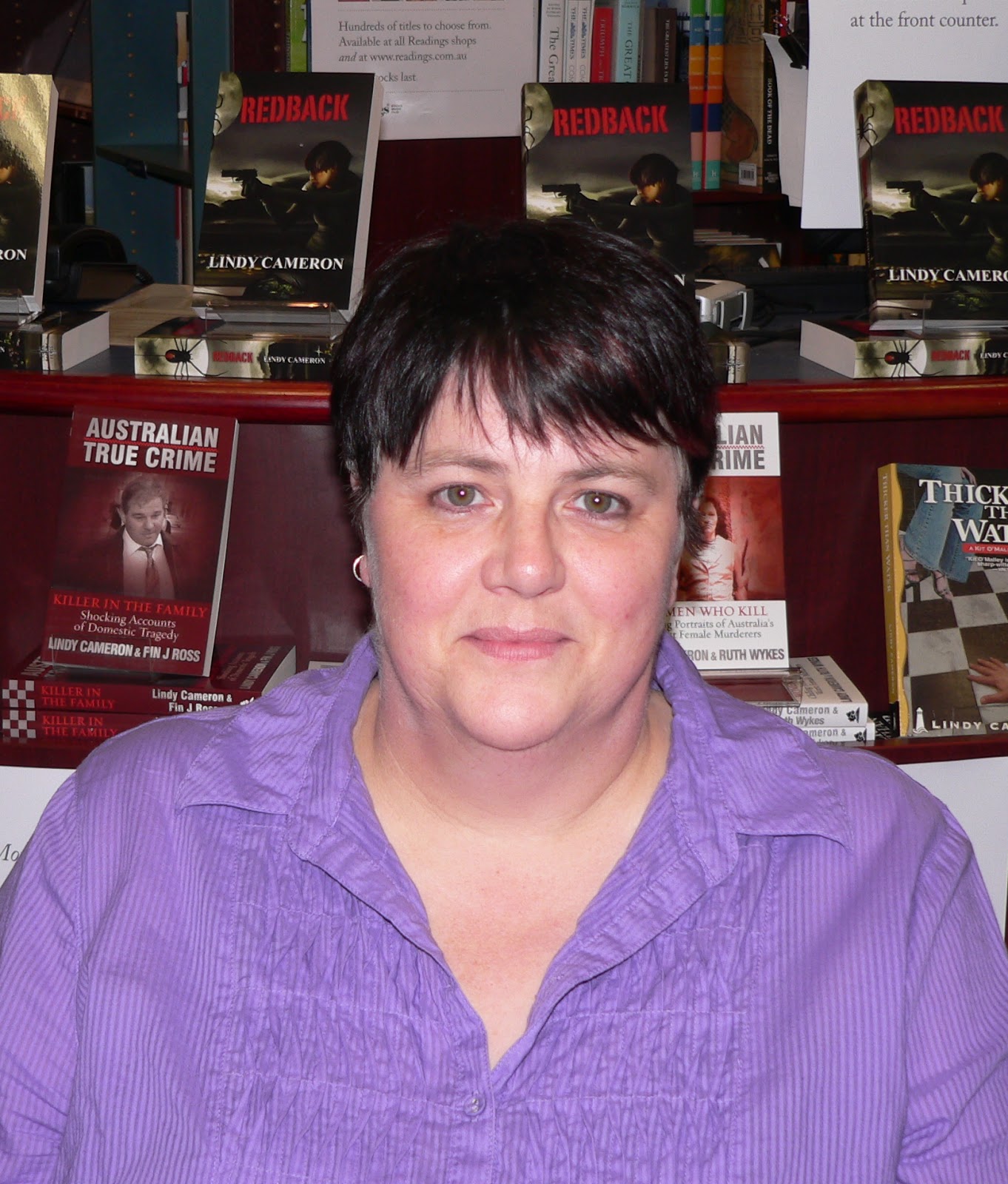
Interview with Lindy Cameron


Our guest today is Lindy Cameron. Lindy is also the author of the Kit O’Malley PI trilogy Blood Guilt, Bleeding Hearts and Thicker Than Water; the archaeological mystery Golden Relic; the action thriller Redback; and the sf crime Feedback. She’s also co-author of the True Crime collections: Killer in the Family & Murder in the Family, with her sister Fin J Ross; and Murderous Women, with Ruth Wykes. Lindy is a National Co-Convenor of Sisters in Crime Australia, the Publisher of Clan Destine Press, and is currently working on a series of historical novellas featuring time-travelling archaeologists. You can connect with Lindy via her website, Twitter and Facebook.

As Lindy is sitting on our Pathways to Publication panel on Sunday 10 September at the HNSA 2017 Melbourne conference, we thought we should find out more about her. 

As the national co-convenor of Sisters in Crime Australia, and owner and publisher of Clan Destine Press, can you tell us what first prompted your interest in reading and writing crime fiction and nonfiction?

My reading life began with The Famous Five, progressed through Biggles and James Bond to authors Helen McInnes and Agatha Christie to Sara Paretsky and the modern women crime writers.
There was actually little chance I’d write anything but crime and action.

Why, in your opinion, are writers attracted to writing historical crime fiction dating back through the centuries, and/or exploring true crimes?

Plot – I think. If you have a murder or a mystery to hang your historical garb around then, as a writer, you’re playing in the best of both worlds. A crime or mystery is a great way to introduce readers to a time and place far removed from them; and in a way that does not have to rely on the Big Names of History to tell the story. A mystery in Ancient Greece or Rome can be all about the citizens, or the slaves or the merchants. A murder at any time in history is still a murder that needs solving; or even perpetrating! A mystery stands right next to a quest as a great foundation for any historical novel.

Can you tell us a little about how you go about researching and writing your crime novels? What sorts of resources do you use?

I’m currently writing historical fiction: a mosaic novel (series of novellas) with the about time travelling archaeologists and adventures.So, my research takes me into the gurgling black hole whole of google and all that the internet opens up to writers researching anything really, but the past in particular. There is SO much information to find, and ways to track down original sources, or actual books on topics on everything ancient, like weapons, poisons and Amazons, female archaeologists and aviatrixes from the 19th-21st centuries. Research for my (contemporary) crime fiction follows the same route, with the added bonus that, as a member of Sisters in Crime, I have access to a Sisterly host of real-life experts in real-world crime solving. Sisters in Crime Australia, by the way, has been celebrating, promoting and having fun with women's crime writing for 25 years. It is, arguably, one of the best groups in the country for readers, viewers and writers of anything.

Are you a 'plotter' or a 'pantser'. What's next in the pipeline for you?

I’m a plotting-pantser – depending on what I’m writing. With ‘time travel’ stories a certain amount of plotting s vital or your character might end up scrubbing themselves out of their own future.
I usually start with an idea that gets pantsed; then I stop to work out where on earth I’m going, outline a few plot details, then rush  off  again like a loon.
My current project is a series of novellas set in different time periods but all linked to the concept of the first in the series: 
A tale of Amazons and the Great Library of Alexandria in which a time-travelling archaeologist and a writer from the 21st century meet the great-great-great granddaughter of Queen Thalestris and Alexander the Great.

Which is more important to you: historical authenticity or accuracy?

They are both vital – but it depends whether a story is being presented as fact. In my first novel, Golden Relic, I invented an Incan myth to suit the modern mystery that was unfolding. But the myth was rooted in heaps of research and tied to a fabricated (by me) account by a Spanish missionary of an inciting incident. Everything I created had a basis in some kind of fact, so the story was ‘authentic’ rather than accurate.

How important is it to you to feature gay and lesbian protagonists in your books and at the same time raise issues of concern to the LBGTQIA community?

In terms of my writing, I’m a writer first; then a lesbian writer. My first book had a mention of a gay guy; my next three books (the O’Malley Mysteries) star a lesbian private investigator; my fifth novel - the action adventure Redback – is more gay subtext than overt but it’s there. It’s very important to me write with as much diversity as possible. But I don’t write anything to raise LGBTQIA issues. Yes, they may present themselves, but that is never my starting point. I want my characters to be themselves without drawing attention to themselves by waving a big rainbow or feminist or political placard. It doesn’t mean I shy away from anything either. I am what I am; just like my characters.

What made you decide to become a publisher as well as an author?

Ah, the $6 million question. Because I was brave; and stupid. All too often my writer friends and I would say: ‘If I ran my own publishing company… I would publish that; or encourage this; or develop that idea. I finally realised I had most of the necessary skills; or knew talented people who did – so I thought, why not give it a go. As I love genre fiction, of all kinds, that was the pond I jumped in – and was lucky enough to launch Clan Destine Press in 2010 with Out of the Black Land, a previously unpublished historical novel by Kerry Greenwood.

We now have 30 authors and nearly 50 books, and have published crime and suspense and action and romance and YA fantasy and true crime; and another three historical novels by Kerry Greenwood.

How do you divide your time between writing and your role as a publisher?

Poorly. The publishing has taken over but I am clawing my writing time back so I can finish my big historical project.

Can you give some guidelines to aspiring authors as to how they might contact Clan Destine Press with the idea of submitting a proposal?

All the guidelines are on our website – and they are pretty standard.We are looking for more historical fiction though – of any era. Storytelling is everything for us; and great characters; and –  authentic or accurate, depending on the style.

Any tips for 'must reads' - particularly in the historical fiction genre?

The following are my favourite historicals – some written as historical fiction; some just plain historical: Homer’s The Iliad and The Odyssey, Vergil’s The Aeneid, Herodotus’ Histories, Ibn Battutah’s The Travels of Ibn Battutah, Kerry Greenwood’s Medea (not Euripides), Stephen Pressfield’s Last of the Amazons, Margaret Mitchell’s Gone with the Wind, Leon Uris’ Exodus, James Michener’s Hawaii, Catherine Gaskin’s Sara Dane.


When Professor Lloyd Marsden is found murdered in the Museum of Victoria, Special Detective Sam Diamond is assigned to catch the killer.

Thrown into a world of obsessive collectors, strange poisons, funerary rites and ancient artefacts, Sam's photographic memory and cryptic crosswords skills are invaluable tools in her investigation.
But when archaeologist Dr Maggie Tremaine whisks her half way round the world in pursuit of the truth, Sam finds more questions than answers.

Was the murder an attempt to sabotage the international museum conference? Is the Rites of Life and Death exhibition a front for something more sinister? Why have Marsden's colleagues also died of unnatural causes? And who is the man in the fez following their every move?


Many thanks Lindy!

Lindy Cameron's books are available from Clan Destine Press.

HNSA 2017 Conference

The HNSA 2017 Melbourne Conference is being held on 8-10 September 2017 at Swinburne University. Lindy Cameron will be appearing in the following panel in Session Five on Sunday 10 September at 2.30-3.30 pm.

Pathways to Publication: What do Agents and Publishers Look for in Historical Fiction?

What are the expectations of publishers and agents when assessing the manuscripts of aspiring historical novelists? Publisher Lindy Cameron (Clan Destine Press) talks to agent, Clare Foster (Curtis Brown) and publishers Alison Green (Pantera Press) and Mandy Brett (Text Publishing) about the preparation needed to take your first step onto the pathway to publication.

Lindy is also appearing at our 'Meet the Author' satellite event on 18 June 2017 at 2.30-4.30 pm at the Mail Exchange Hotel, 688 Bourke St, Melbourn,e discussing Ancient and Medieval Historical Fiction with Barbara Gaskell Denvil, Paul Hansen, Rachel Nightingale and Linda Weste. Bookings available via Trybooking.

The 2017 HNSA Conference is a celebration of the historical fiction genre which will showcase over 60 speakers discussing inspiration, writing craft, research, publishing pathways and personal histories in our weekend programme. Among the many acclaimed historical novelists participating are Kerry Greenwood, Kate Forsyth, Deborah Challinor, Libby Hathorn, Lucy Treloar, Sophie Masson, Sulari Gentill, Robert Gott and Arnold Zable. The HNSA’s speakers’ list is available on the HNSA website.

In addition to the two stream weekend programme, there will be ten craft based super sessions and two research masterclasses. You won’t want to miss our interactive sessions on armour and historical costumes either! Manuscript assessments will be conducted by industry experts, Alison Arnold and Irina Dunn. Our free extended academic programme is open for general admission but bookings are essential.

Our First Pages Pitch Contest offers an opportunity for submissions to be read aloud to a panel of publishers. And we are delighted to announce the introduction of our inaugural HNSA Short Story Contest with a $500 prize!


Let’s make a noise about historical fiction!