

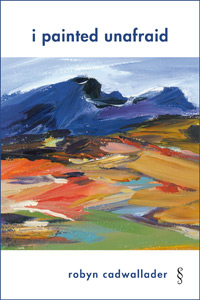
Today we are delighted to welcome Robyn Cadwallader to the blog. Robyn is an editor and writer who lives in the country outside Canberra. She has published poems, prize-winning short stories and reviews, a poetry collection, i painted unafraid (Wakefield Press, 2010) and a non-fiction book about virginity and female agency in the Middle Ages. Her first novel, The Anchoress was published to critical acclaim in 2015 by Fourth Estate (Aust), Faber & Faber (UK), Farrer, Straus & Giroux (US), and Gallimard (France). It was awarded a Canberra Critics’ Circle Award for fiction, was shortlisted for the Indie Book Awards, the Adelaide Festival Literary Awards and the ACT Book of the Year Award, and was longlisted for the ABIA Awards. In response to the government’s shameful policies on asylum seekers, Robyn commissioned and edited a collection of essays and analysis by prominent lawyers and activists, We Are Better Than This (ATF Press, 2015).
You can connect with Robyn via her website and blog, Facebook, Twitter @robyncad and Instagram RobynCadwallader.
You can connect with Robyn via her website and blog, Facebook, Twitter @robyncad and Instagram RobynCadwallader.
What is the inspiration for your current book?
I first found out about anchoresses when researching for my PhD. I was so fascinated by the idea of women choosing to be locked away, that — even though it seemed unlikely material for a novel — the idea wouldn’t let go of me. When I visited some of the few anchorholds still standing in the UK, I began to imagine one women in her cell, wondering what it would be like, why she was there, how she would survive. She became Sarah in my novel.
Is there a particular theme you are exploring in this book?
There are several interwoven thematic strands in the novel, that emerged via writing about the experience of one anchoress. I’m very interested in the ways in which religious, philosophical and medical teaching from the ancient world through to the Middle Ages constructed the female body as sinful and dangerous, and required it be controlled. It’s the story of patriarchy, of course, and it’s writ large in the imagery of an anchorhold, where a woman is literally sealed into a stone cell, described as dead to the world, and instructed not to look out at the world. The novel explores the ways that the body is nonetheless resistant to control and Sarah discovers that her sensual life, and those of the ordinary village women who visit her, lead her toward God. A sub-theme (is there such a thing?) that I really enjoyed writing about is the variety of ways in which the written word can be used —to encourage, to control, to tell stories and even as a means of resistance, to blackmail the church.
Which period of history particularly interests you? Why?
I can become fascinated in whatever period I read, I think. But the Middle Ages, and specifically England in the thirteenth and fourteenth centuries, grabbed my attention via the literature. Many people (my uni students among them) assume that medieval literature is dry, dusty and always religious, but the stories are vibrant, gutsy, often funny and bawdy. The literature opened up the culture and history for me. It’s fascinating to read about the fourteenth century, a time on the cusp of the Renaissance, but such a gruelling time of famine and climate change, near civil war, plague and a peasants’ rebellion against the crown that almost succeeded. Somehow, people still survived (well, some of them) and created.
What resources do you use to research your book?
Apart from Julian of Norwich’s writings, there are no primary texts by anchoresses. So, I read the many rules written for these women, primarily the thirteenth-century Guide for Anchoresses or Ancrene Wisse, that reflects the contemporary attitude toward women as it offers advice on the inner and outer life of an anchoress. Beyond that, I visited anchorholds and their remains in the UK, I read archaeological evidence about anchorholds, theological writing about women from the early Church Fathers and some later medieval theologians; documents such as cartularies, manor court rolls and statutes; rules of life for monasteries and priories along with maps of villages and priories. Secondary material included descriptions of villages and village life; the creation of manuscripts and a thousand details of medieval life for the nobility and peasantry. I also found feminist and literary discussions of anchoritic life especially helpful for giving me ways to understand the significance of the primary material I was reading.

What is more important to you: historical authenticity or accuracy?
Authenticity, for sure. We can’t know absolutely what life was like in the past, and whatever we read or write about the past, we do so through the lens of the twenty-first century. It can’t be otherwise. So, while I work hard to be as accurate as possible, my primary interest is in writing an engaging and thoughtful story. I think of my writing as a kind of conversation between myself and the past.
Which character in your current book is your favourite? Why?
Of course I love Sarah, the main character of The Anchoress. I spent so long inside her head, after all! But Eleanor, the little girl who visited Sarah, is my favourite. She has such natural spunk and curiosity, and best of all, she draws out the reclusive scribe, Ranaulf. When I began writing, my own thought was that the village children would be naturally intrigued by this woman locked away where they couldn’t see her: why would she be there? What would she do all day? When was she coming out? I didn’t plan any further than that, but Eleanor kept coming back, and slowly she became incredibly important to Sarah. She was easy to write, as if she insisted on being in the novel in exactly the same way that she insisted on chatting with Sarah; she was always simply ‘there’.
Are you a ‘plotter’ or a ‘pantser’? How long does it generally take you to write a book?
I’m a thorough pantser. No idea where I’m headed beyond a vague sense of the story’s general shape. I love the feeling of writing something completely unexpected that takes the story in a different direction from what I had imagined. Even better, is coming back to a scene or image that had seemed random and perhaps irrelevant, to the connections it makes to other areas of story and character. My image is the familiar one of driving down a country lane, this time in my old VW beetle with terrible headlights, able to see only a few metres ahead of me; all I can do is trust that by the time that ground is covered, the next few metres will come into view. It doesn’t always happen and sometimes it’s overwhelming, sometimes I end in a ditch, but it’s the process that I trust.

Which authors have influenced you?
As a writer of historical fiction, I have to say Hilary Mantel, primarily, for her capacity to write about history with such wit and such strong characters, not an ounce of history-speak. I also love Jim Crace’s approach to historical fiction as well. They both grasp the authority and creativity of the writer first of all, unconstrained by the idea of writing about history. I know Mantel takes accuracy seriously, but she can push outside that when she wants to, and it works so well. I’m in awe of them both.
What advice would you give an aspiring author?
Be wary of any advice that is absolute, any do, don’t or should. So, this is what I tell myself: read, write and write some more. Be brave, take risks. Trust yourself. I’ve found that writing historical fiction, I have to continually be aware of the dangers of being stifled and falling into ‘history-speak’ (see question 8), that slightly artificial way of writing and story telling. I try to stretch out my literary arms and write with some freedom, letting the characters be people, not historical mouthpieces.
Tell us about your next book or work in progress.
My next book is set in early fourteenth-century London and tells the story of a group of secular illuminators of medieval manuscripts.
From a remarkable new Australian author comes THE ANCHORESS, a story set within the confines of a stone cell measuring seven paces by nine. Tiny in scope but universal in themes, it is a wonderful, wholly compelling fictional achievement.
Set in the twelfth century, THE ANCHORESS tells the story of Sarah, only seventeen when she chooses to become an anchoress, a holy woman shut away in a small cell, measuring seven paces by nine, at the side of the village church. Fleeing the grief of losing a much-loved sister in childbirth and the pressure to marry, she decides to renounce the world, with all its dangers, desires and temptations, and to commit herself to a life of prayer and service to God. But as she slowly begins to understand, even the thick, unforgiving walls of her cell cannot keep the outside world away, and it is soon clear that Sarah's body and soul are still in great danger ...
Telling an absorbing story of faith, desire, shame, fear and the very human need for connection and touch, THE ANCHORESS is both mesmerising and thrillingly unpredictable.
Many thanks for sharing your journey with us, Robyn.
You can purchase Robyn's books via these links:
The Anchoress, i painted unafraid, We are Better Than This and Three Methods for Reading the Thirteenth-Century Seinte Marherete.
Venturing forth: Exploring Stories beyond National Boundaries and Australasian History
Kelly Gardiner discusses with Robyn Cadwallader, Natasha Lester, Prue Batten and Elisabeth Storrs why some authors prefer to discover worlds beyond their native shores and ancestral history.
Many thanks for sharing your journey with us, Robyn.
You can purchase Robyn's books via these links:
The Anchoress, i painted unafraid, We are Better Than This and Three Methods for Reading the Thirteenth-Century Seinte Marherete.
HNSA 2017 Conference
The HNSA 2017 Conference in Melbourne is being held on 8-10 September 2017. This celebration of the historical fiction genre will showcase over 60 speakers discussing inspiration, writing craft, research, publishing pathways and personal histories in our weekend programme. Robyn Cadwallader will be appearing on Saturday 9 September in Session 2.15-3.15 pm.Venturing forth: Exploring Stories beyond National Boundaries and Australasian History
Kelly Gardiner discusses with Robyn Cadwallader, Natasha Lester, Prue Batten and Elisabeth Storrs why some authors prefer to discover worlds beyond their native shores and ancestral history.
Among the many acclaimed historical novelists participating are Kerry Greenwood, Kate Forsyth, Deborah Challinor, Lucy Treloar, Sophie Masson, Sulari Gentill, Robert Gott and Arnold Zable. The HNSA’s speakers’ list is available on the HNSA website.
In addition to the two stream weekend programme, there will be ten craft based super sessions and two research masterclasses. You won’t want to miss our interactive sessions on armour and historical costumes either! Manuscript assessments will be conducted by industry experts, Alison Arnold and Irina Dunn. Our free extended academic programme is open for general admission but bookings are essential.
Our First Pages Pitch Contest offers an opportunity for submissions to be read aloud to a panel of publishers. And we are delighted to announce the introduction of our inaugural HNSA Short Story Contest with a $500 prize!
Let’s make a noise about historical fiction!


