
Wednesday, March 18, 2015

Ian. D. Roberts: In search of something old that's new

ID Roberts has been a wonderful supporter of the HNSA conference. Even though he is on the other side of the world, he donated to the Pozible campaign and then offered the prize of one free day ticket to another lucky attendee. To acknowledge his support, we're publishing a great post where he explores how historical research can be blended seamlessly to produce historical fiction.


I.D. Roberts was born in Ivanhoe near Melbourne, Australia in 1970 and moved to England when he was three. From a young age he developed an obsession with war comics, movies, Tintin and James Bond.

At various stages in his life he has worked as a filmmaker, an industrial temp, a cinema box-office cashier, a runner, a caretaker, a football correspondent, a police line-up volunteer, a cricket commentator, a soundtrack reviewer, and a sub-editor. For the past decade he has been the film writer for the TV Times magazine. In 2012 he was signed by a literary agent.

He holds a BA in Film from the University of Westminster and an MA in Creative Writing from Bath Spa University. 

His debut novel, KINGDOM LOCK, an action-adventure set during the First World War, was published in May 2014 by Allison & Busby.

The second Kingdom Lock adventure is done, and he recently completed an adaptation of his grandmother's memoirs. It tells of her time as a trainee nurse during the Blitz, and is due to be published by Little Brown (Sphere) in August 2015. 

He lives in rural Somerset with his wife Di and their dog, Steed.


 In search of something old that’s new

One of the questions I find myself being asked the most by readers, when I meet them, is about research. How much do I do? How did I find a particular thing out? And did it take me a long time?
And it’s not just the readers, either, who ask those questions. My fellow writers and I often talk and discuss the merits and disadvantages of research, of how much is too much, of getting bogged down in fascinating details, and of actually forgetting to get on with the actual writing of our stories. But the one thing that we all agree on, is that research can be pretty addictive, particularly when you have uncovered, or been shown or told about, some new piece of fact related to your chosen era. 

So, just how much is too much when it comes to research?

If the truth be told, you can keep working on something over and over, always improving, always tinkering, always adding something else to enhance the whole. There is so much information out there nowadays and there are always more books, more essays, more photos, letters, memoirs, maps, films to study. And let’s not forget the reference libraries to visit, the historical sites to discover, the cities to travel around, the battlefields to walk, and the people to read about and to talk to. Research really never ends. It is an integral part to all writing, and, I would say, the life blood of historical fiction in particular. 

But certain authors will use their research in different ways.
 
For example, in Historical Fiction, a literary author may go into huge, intricate detail about, say, a tablecloth. Whereas, for a commercial writer like myself, that kind of detail would be far too intricate and distracting, and would best be mentioned in a line, if at all. However, but both types of author could easily embark on the same amount of research. For authenticity, I may want to check that the tablecloth was made of cotton, was white, and decorated with colour, hand-stitched wild flowers. Whereas the literary author may wish to delve into the history of the tablecloth itself, writing about its weave, its construction, how the cotton was harvested in the first place, how it was bleached or how the seamstress lost her eyesight while sewing on the intricate flowers. Going off on tangents for page after page after page. 

Both are just as valid, they are just two totally different styles of storytelling. And both equally need research of some level.

My own research for the Kingdom Lock stories is still ongoing. And I don’t think it will ever really end. It’s amazing how I keep uncovering new and interesting things about the period: 1914-18; the area I set my stories in: Mesopotamia and Persia; and some of the historical characters involved. 

I think, what with the current interest in the First World War, more and more documents are being unveiled all the time, and more and more information is being revealed about certain situations and people during that rich period of history. I peruse old diaries, military reports, maps and photographs, as well as hunting out new and fascinating books (both recent and old) related to the war. More often than not there is some little gem, somewhere inside them, that I store away for use in a later story. And it’s amazing how much films and fiction produced both during the war and since can help, too. I value those as highly as I do history books.

An example of a recent piece of research I had to undertake for my second Lock adventure, For Kingdom and Country, was trying to discover the type of smart evening wear officers would dress in whilst dining out in a hot climate. I knew that they couldn’t possibly wear the familiar short red mess jackets, far too stifling, but try as I might I just couldn’t find anything out. Then I happened upon a great Australian website run by a bloke who went into intricate details about military uniforms of all eras. I emailed him with my problem and a mere few days later not only did I get a detailed reply, but it was also illustrated with various colour drawings of hot weather mess attire (white jackets, in case you wanted to know). 

Of course, I could have written the scene in such a way that I didn’t have to mention the exact type of uniform worn, but I wanted the section of my story, as I do with all my writing, to feel authentic. Yes, white dinner jackets are not integral to the tale, and a reader may not even register the fact, but I do and I feel it is these little details that give Historical Fiction, and my work, believability. 

If a writer can decorate their story with intricate details based on fact, then it helps to make the world they’ve created and set their story in authentic and real. After all, Historical Fiction is time travel for a reader. It is a way of exploring new worlds, old worlds really, and of delving into the past and living there for some 300 to 400 pages or so.

Research goes on and you can never win, you can never do enough. For an author, the trick is knowing when to stop; it is knowing when to put down the history books and the diaries and the memoirs , it is knowing when to pick up the pen


Visit I.D. Roberts at his website or tweet @kingdomlock

Featured Book
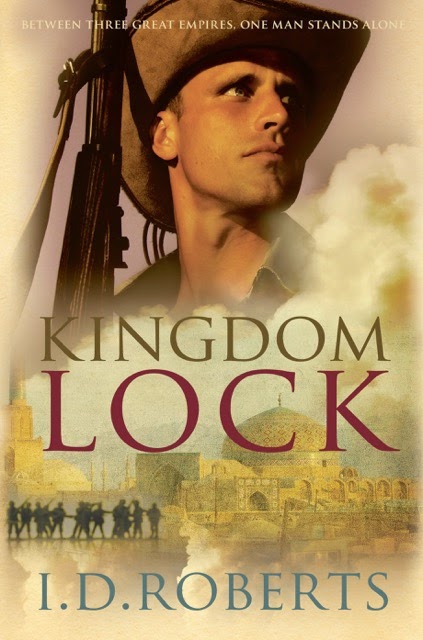
https://www.waterstones.com/book/kingdom-lock/i-d-roberts/9780749016302 

The ground in front of Lock kicked up a spray of snow. Moments later a gunshot rang out, echoing loudly off the mountainside. Lock felt Amy tense as he staggered and turned. On the furthest ridge behind them, no more than a mile away, there were now three men on horseback. 'Bugger!' Lock turned away and laboured on. He tried to think only of their escape and not the impact he would feel when the expected bullet pierced his body ending his mission. Not long now, a voice in his head whispered, it won't take long for their pursuers to cover the gap between them on horseback. Hide! We need somewhere to hide, his subconscious screamed. But he could see nothing, only a barren, harsh, unforgiving landscape.

For more information on all our panels, please visit our site for program details. And you can buy your tickets here.


You can also sign up to the mailing list to be the first to keep up to date with breaking news on the HNSA conference in 2015. 

Please consider visiting us on Twitter and Facebook to help us spread the word! 


And please take a look at our FREE BOOK OFFERS! 

The first 30 ticketholders to purchase a ‘Standard’ Whole Conference Ticket will receive a free copy of either The Lace Balcony by Johanna Nicholls, The King’s Shadow by Barbara Gaskell Denvil or The Island House by Posie Graeme-Evans. 
 
All ticket holders will receive a Momentum ebook bundle in celebration of Felicity Pulman’s launch of Unholy Murder.

The first 50 fully paid ticket holders will receive a copy of Sherryl Clark’s new book Do You Dare – Jimmy’s War in celebration of her launch. 


Monday, March 16, 2015

A love of history: Wendy J Dunn interviews Gillian Polack


We have a special treat today on the HNSA blog as Wendy J Dunn interviews author and historian Gillian Polack. Wendy is speaking on the What is it about the Tudors? on the 22 March in Session Two. Gillian is participating in the round table debate at our opening reception at the State Library of NSW on 20 March 2015. She will join Kelly Gardiner, Jesse Blackadder, Rachel Le Rossignol and Deborah Challinor in pondering the topic 'What can historical novelists and historians learn from each other?' Both Wendy and Gillian will be participating in Phryne Fisher and Other Fantasies  on 22 March where an academic panel will discuss this topic. This session is free and is open to all but it is separately ticketed.

Gillian is also running a super session on Historical Fiction Writing and Research to assist writers to weave their research into compelling fiction.


Dr Gillian Polack is a Medieval historian and has PhDs in both History and Creative Writing. She researches how history and fiction interface and has a strong interest in how genre narratives operate. She has also been a reviewer, critic and non-fiction writer and an award judge. Gillian has two novels published (Ms Cellophane/Life through Cellophane was a Ditmar finalist) and has one forthcoming (Langue[dot]doc 1305). Sixteen of her short stories are in print and she has edited two anthologies (Baggage was a Ditmar finalist) and an historical cookbook.  One story won a Victorian Ministry of the Arts award and three more were listed as recommended reading in international lists of world’s best stories. She has received two writing fellowships at Varuna, arts grants, and a Ditmar award for her work.Her  latest book, The Middle Ages Unlocked: A Guide to Life in Medieval England 1050-1300 is co authored with Katrin Kania, and is now available.

You can visit Gillian at her website or Facebook or on Twitter.

Wendy J. Dunn is an Australian writer who has been obsessed by Anne Boleyn and Tudor History since she was ten-years-old. She is the author of two Tudor novels: Dear Heart, How Like You This?, the winner of the 2003 Glyph Fiction Award and 2004 runner up in the Eric Hoffer Award for Commercial Fiction, and The Light in the Labyrinth, her first young adult novel. After successfully completing her MA (Writing) at Swinburne University Wendy became a tutor for the same course. She gained her PhD (Human Society) in 2014. 


You can visit Wendy at her website or Facebook or at Goodreads.

Wendy J Dunn
Years ago, I had the great pleasure of interviewing Gillian Polack. While my interview needs a bit of updating because Gillian has now a total of four published novels ILluminations (Trivium), Ms Cellophane (Momentum), Lagnue[dot]doc 1305 (Satalyte) and The Art of Effective Dreaming (Satalyte), overall it is still very relevant, interesting and offers wonderful insights about this very talented, amazingly intelligent and very generous woman who combines the love of both chocolate and history with debatable equal passion. 

http://www.amazon.com/Langue-dot-1305-Gillian-Polack/dp/099255800X


Wendy J. Dunn: I’m interested in hearing about your journey from medieval historian to an author of fiction. What comes first for you – writing imaginatively or being a historiographer?

Gillian Polack: That is surprisingly difficult to assess. I have wanted to write fiction since I was eight, but my family heavily dissuaded me, so I wrote for myself until I was nineteen.  By that time I was already studying history and historiography as an undergraduate.

Thinking about it, my interest in history is about as old as my interest in writing fiction, which is why I studied it at university (to more family protests!).  My love of history was more a vocation than a potential career – it still is.  I was the daughter who dragged the whole family into rural museums while we were on holiday and exclaimed over old shoes and pre-electric irons.  I had to investigate roadside markers and the plaques on trees.  I asked older members of the family about their lives and was told a thousand family stories.

How entangled are these two parts of myself?  Inextricably.  I used my Arthurian self as a backdrop to “Illuminations” and am planning books using a fantasy Middle Ages.  I use my historian’s sense of Australia and family in writing my current novel and the last one (still in search of a home)  – it all comes out in my fiction.

W.J.D.: Has writing your novels changed you in ways unexpected?

G.P.: Absolutely. The big thing it has given me is a sense that I am allowed to be myself. The more people tangle my fictional characters with me, and the more fictional characters of mine get seen that way, the more license I seem to have to be the somewhat quirky person I am, and to keep following my dreams.

It was more important for me to do things for other people than to be there for myself, but now I find myself saying, “If I get too sick, I can’t write all the books I have inside me.”  I am a lot more self-centred than I used to be and vastly more self-confident.

W.J.D.: You know, eight seems to be important age when so many of us begin to know the road we want to walk in our lives, What writers influenced you in your early years? And when did the Arthurian legends/genre first draw you in?

G.P.: Oddly that is two questions for me.  Let me answer the second one first. I know that most Arthurianish people are addicted to things Arthurian from their formative years, but I wasn’t.

I loved T.H White and Rosemary Sutcliffe and Mary Stewart from when I was young, but at the same time I hated Mallory (and still don’t adore him, to the consternation of my students).

Arthuriana became central to my reading during my doctorate, partly because I was able to read the glorious Old French prose tales, and partly because everyone kept bugging me to tell them about these tales. What kept me Arthurian after that was that people wanted to know more and more, so I had to read more and more.  And so I discovered what great fun are modern tellings of Arthur, and now I enjoy them as themselves.

My natural bent when I was young was for pure science fiction and for non-Arthurian fantasy.  When I was eight I loved Sylvia Engdahl and Andre Norton and ‘Doc’ Smith and the early Heinlein.   I read them alongside Elizabeth Beresford and the Abbey books and Edith Nesbit and Anya Seton.

My tastes extended just as far as the libraries I had access to would allow. As fast as four books at a time permitted, I worked my way through every library I had access to and read non-fiction as avidly as fiction.

My parents had the wonderful principle that I was allowed to read anything. This was a very powerful teaching decision on their part:  it helped me grow through my reading. In my early teens I discovered for myself that Dostoyevsky was awesome, that Chekhov was subtle, that Nabokov was ick, and that Dickens was often boring.

For me, the big truth about my early reading was not what influenced me, but the fact that I was given this authority from very young to be critical and to think through what I was reading. Every book I read counted, whether written by a big name or by someone who has already been forgotten by everyone else.

I still keep a lot of my favorites from different points in time, so I can walk through my home library and point to my developmental stages.  I can see the moment I stopped collecting Enid Blyton because I suddenly realised just how much she played on ‘us’ and ‘them’ and how totally ineffectual most adults were in her society.  Or when I started reading Tolkien’s other books, because his societies became more interesting to me than the adventures of a single hobbit.

If any author interested me in history early, it was Hilda Lewis.  After reading her fantasy about a time-travelling ship, I started reading historical fiction as well as science fiction and fantasy.  Rosemary Sutcliffe became as close to me as Andre Norton.


www.amazon.com/Middle-Ages-Unlocked-Medieval-1050-1300/dp/1445645831/www.amazon.com/Middle-Ages-Unlocked-Medieval-1050-1300/dp/1445645831/

W.J.D.: Another question if you’d care to answer. Tell us about your new novel and the works you have on the boil…

G.P.: Always happy to talk about these things, but I will try not to say too much.
Firstly, The Art of Effective Dreaming.  When people ask, I tell them, “It is about Australian public servants and dead Morris dancers.”  Actually, it is about that moment when you are just about to sleep and all your dreams spring to life in your mind.  And it is about how we use our dreams to create our lives. It just happens to have public servants and dead Morris dancers in it as well. I can’t tell you exactly when it will be out, but keep an eye on Trivium Publishing’s website because that is where the announcement will appear.

The rest of my books are a bit complex. I am revising one and writing another and planning three more, all at once.

The one I am revising is Secret Jewish Women’s Business :  family secrets,anti-Semitism, magic, sisters, and echoes of domestic violence.   It is set mostly in Sydney, but with bits of Canberra and Ballarat.

My work-in-progress is Life through Cellophane which I like to call a domestic drama with slivers of horror.  There are mid-life crises and boyfriends and an evil boss and impossible families and a very, very strange mirror.  There are also ants.  Lots of ants.

The ones I am planning to write after Life through Cellophane take me back to fantasy Middle Ages.  This time it is the twelfth/thirteen century (Not Arthurian Britain).  I want to write three linked books (not a trilogy!). Right now I am still developing background and having a whale of a time.  I am enjoying it so much that I have put hints of what is to come in Life through Cellophane - the Middle Ages sneaks in everywhere.

W.J.D.: Can I toss in one last question? I really want to ask you about your fascination with food in fiction…?

G.P.: My historian side has done some work on culinary history and has taught everything from Ancient Roman to modern Jewish cuisines.

Like everything else in my life, the love of food and food history refuses to stay neatly packaged into its own little space, and crept into my fiction. My historiography and Arthurian studies led to Illuminations and to my particular take on the Arthurian tales. My folk interest gave folksongs and Morris dancers to The Art of Effective Dreaming and my food history has given me a full background of recipes for Secret Jewish Women’s Business. When/if the latter gets published, I promise to web a few recipes.

When I think about it, I suspect it is the fact that I study cultures and the fabric of people’s lives and their writing. This means there are many natural links between my studies and my fiction writing, even though I try to tell people that I keep the historian and writer quite separate. The type of historian I am produces material of vast interest to the type of fiction writer I am, I guess.


http://www.amazon.com/dp/B00OWTPOO2

20 March 7.30 pm – ROUND TABLE DEBATE
Enjoy a lively round table discussion with Kelly Gardiner (Chair), Deborah Challinor, Jesse Blackadder, Rachel Le Rossignol and Gillian Polack as they ponder the question: ‘What can historical novelists and historians learn from each other?’

22 March 9.45-10.45 am  Session Two
What is it about the Tudors?
The world’s appetite for historical fiction set in Tudor times continues to grow. What is it about this particular royal house that is so compelling? Are publishers ‘playing it safe’ by not encouraging novels set in other eras? What impact has Tudor fiction had on the popularity of historical fiction as a genre? Rachel Le Rossignol  joins Natalie Grueninger, Wendy J Dunn, Barbara Gaskell Denvil and Jane Caro will explore the phenomenon of Tudorphilia.
  
Library Meeting Room 1      11.00 am – 12.00 pm           Session Three
Phryne Fisher and Other Fantasies: The Female Detective in History

A panel of academics will discuss at length this theme ‘Phryne Fisher And Other Fantasies: The Female Detective In History’, the subject of a forthcoming special edition of ‘The Australian Journal of Crime Fiction’.

‘The Australian Journal of Crime Fiction’ publishes scholarly and critical studies of work that fall within, or challenge the conventions of, the crime fiction genre.
Panellists include: Dr Rachel Franks, Dr Rachel Le Rossignol, Dr Kelly Gardiner, Diane Murray and Wendy J. Dunn.

For more information on all our panels, please visit our site for programme details. And you can buy your tickets here.

You can also sign up to the mailing list to be the first to keep up to date with breaking news on the HNSA conference in 2015.  

Please consider visiting us on 
Twitter and Facebook to help us spread the word! 

Here’s a tweet you might like to use:


Here’s a interview with @gillianpolack on #HNSA2015 blog @histnovsoc http://ow.ly/KnUJP 

Register now for the #HNSA2015 conference! Let’s make a noise about #historicalfiction http://ow.ly/E9RPZ

And please take a look at our FREE BOOK OFFERS!

The first 30 ticketholders to purchase a ‘Standard’ Whole Conference Ticket will receive a free copy of either The Lace Balcony by Johanna Nicholls, The King’s Shadow by Barbara Gaskell Denvil or The Island House by Posie Graeme-Evans.

All ticket holders will receive a Momentum ebook bundle in celebration of Felicity Pulman’s launch of Unholy Murder. This includes a free edition of Gillian Polack's Ms Cellophane.

The first 50 fully paid ticket holders will receive a copy of Sherryl Clark’s new book Do You Dare – Jimmy’s War in celebration of her launch.